Technology
An Air Dome built with the patented technology
held by a D&W Group affiliateAir Dome (product name: AgDome)
Inside a dome that stands on air, crops are grown less affected by the weather. We explain how it works with simple illustrations.
Structure
A double-membrane dome
that stands on air without pillars
Blowers put a little extra air into the dome to lift the membrane. Because the membrane has two layers, the air layer between them provides insulation.
- Floor area of 1 standard dome
- 1,000 pyeong3,300 m²
- Length × width × height
- 100×32×17mHeight of a 5-story building
Source of figures: Company materials · AgDome standard unit
Standard Specification
Built by repeating one specification
- Length 100m · width 32m · height 17m — built to one specification
- With the same drawings, the same parts and the same work sequence, the next dome is built the same way
- With no pillars, farm machinery can drive right in and work
- A D&W Group affiliate explains that it has put the experience gained from building, repairing and operating more than 20 Air Domes into its current specification and construction sequence
Source: Company materials · AgDome introduction
Growing Environment
What grows crops is light, CO₂, temperature and humidity
Crops grow well because of light, carbon dioxide (CO₂), temperature and humidity, not air pressure. Because the Air Dome is a well-sealed space, these are easy to manage. The membrane uses a light-diffusing film so that incoming sunlight spreads evenly with few shadows.
Public research case · 2016, Protected Horticulture Research Institute, Haman
approx. +34%
Comparing an experimental Air Dome (15×20×8m) with a regular film greenhouse, cherry tomato yield per plant was about 34% higher.
The same trial also recorded periods of midday high temperature and CO₂ shortage, confirming that management is needed.
Heat Management
Designed not to rely on a single heat source
When heating and cooling the dome, a D&W Group affiliate designs its Air Domes to mix several heat sources to suit the situation, rather than relying on just a single one.
Air-source heat
Uses heat from the outside air
Geothermal heat
Uses the constant temperature underground
Water-source heat
Uses the heat held in water
Agrivoltaics
Solar power used alongside farming adds electricity
Source: Company materials · AgDome 'Energy' introduction
Pest Management
Blocking the way in, managed in 4 steps
Because air inside the dome leaks outward, it reduces outside air seeping in through gaps. But that alone does not keep out pests and diseases. So entry is through double doors (an airlock), and even the routes people and materials take are managed.
Prevention
Insect screens, entry hygiene, removing leftover leaves, reducing condensation and excess moisture
Monitoring
Yellow and blue sticky traps, regular observation
Natural enemies · eco-friendly control
Natural enemies and approved eco-friendly materials are used first
Pesticides only when needed
Only registered pesticides, following the limits on number of applications and safety periods
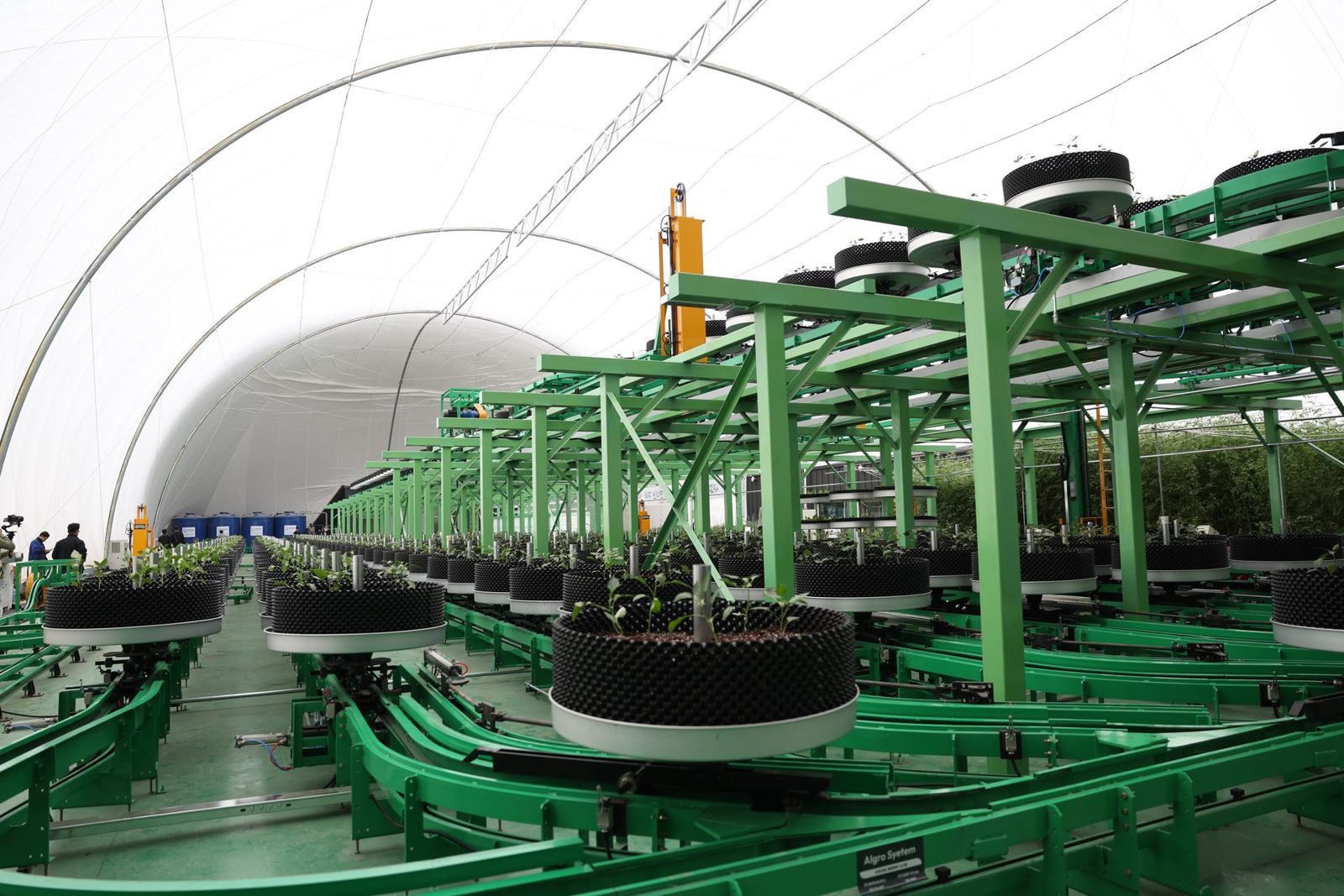
Automated Growing
Pots move on rails
- Pots are not fixed to the floor but sit on rails
- Instead of people walking around, the crops come to the worker
- A lifter moves pots up and down, so the same floor is used in 2 tiers
- 4 pepper plants are grown in each pot, about 1m in diameter
Safety Design
Keeping the dome standing even in a power outage
Because the dome stands on air, the most important thing is keeping the blowers from stopping. So it is designed with three layers of backup.
Backup blowers
If one fails, a backup blower takes over immediately
Automatic switch to emergency power
In a power outage, it switches automatically to an emergency generator to keep the blowers and key equipment running
Emergency operating procedures
Depending on the situation, a person decides whether to keep the dome up or lower it slowly
Operating Program (AgOS)
Read, adjust, and keep records
AgOS is an Air Dome operating program of a D&W Group affiliate. It helps run the dome based on set standards and records, rather than relying only on human intuition.
1. Read
Collects conditions inside the dome
Collects information such as temperature, humidity, CO₂, light, nutrients and electricity use for each dome
2. Adjust
According to set standards
Adjusts the environment to the growing method set for each crop (cultivation recipe) and to work standards
3. Record
As records that can be checked
Keeps the growing environment and delivery details as records that can be checked later
At the Hwaseong Demonstration Site, AgOS adjusts and records the environment inside the dome in real time. In the Hwaseong operating records, the temperature variation inside the dome is ±0.5°C.
This is how the records of one crop are connected
Seeds · cultivation recipe
Which seeds to grow, and by which standards
Growing environment
Environment, nutrients and electricity use while growing
Quality check
Whether it meets the buyer's standards
Delivery records
When, and how much, was shipped
Applied to the next crop
Standards are revised based on the results
Sources· Company materials · AgOS introduction· Hwaseong application and temperature variation: BUCKET BAG introduction video provided by the company (received October 2026)
Operating Principles (AgOS)
AI recommends, people decide
- AI assists with and recommends routine adjustments such as temperature and humidity
- Actions that cannot be undone, such as lowering the dome or discarding crops, are carried out only with the manager's approval
- All approvals and actions are kept as records
- In Hwaseong, growing, harvesting and shipping are recorded in management logs with LOT numbers
Good to Know
Along with the strengths, we disclose the limits
Please keep these points in mind to understand the Air Dome
- If the blowers stop, the dome cannot stay standing. That is why backup blowers and emergency power are essential.
- Heavy snow is handled not by the structure alone but through operations: raising the internal pressure, warming the membrane and clearing the snow.
- It is not yet registered under the government's disaster-resistant facility standards, and the materials needed for registration are being prepared.
Sources of technical explanations· Company materials· Blog series “A Farm Built on Air” (maca_holdings)